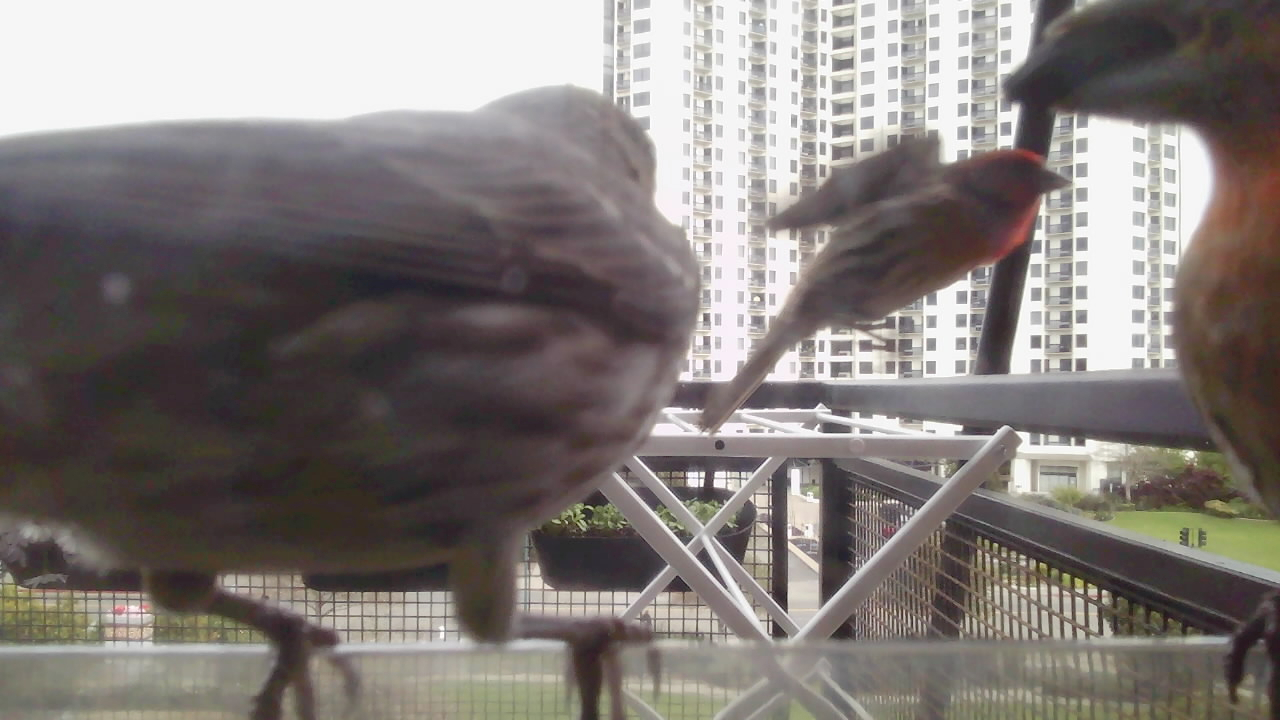
March 31, 1:34 PM — Three House Finches, right up against the camera.
$80 in hardware. 93 lines of Python. 37 cents of AI.
1,500 photos. 433 birds. One answer.
I had one question. Not a startup idea, not a product pitch. Just: when do birds actually show up at my bird feeder?
So I spent a Saturday afternoon setting up a Raspberry Pi Zero 2W with a USB webcam on my balcony in Emeryville. It captures a photo every 60 seconds, adjusts for lighting, and uploads to Supabase. Then I pointed a vision AI at all 1,500 images.
I assumed it would be dawn. It's not. The afternoon window from noon to 5 PM accounts for 70% of all bird activity. Morning contributes 21%. Nights are completely silent — zero birds between midnight and 9 AM.
433 birds across 3 days. Each bar is one hour.
Day 1 had 55 birds. Day 2 had 51. Day 3 exploded to 327 — a 6x increase. The feeder was discovered.
In startup terms, that's a Bird Net Promoter Score of 100. Days 1 and 2 were passives — flat at ~53 visits. Day 3? Pure promoters. Someone told the flock.
Mostly sparrows and House Finches — the ones with the red heads. Occasional pigeons photobombing the camera. And a few frames with something larger that might be a hawk.
Real frames from the camera. Loaded live from Supabase.
A 93-line Python script runs in a loop. Every 60 seconds: capture a 1280×720 frame
with fswebcam, post-process with ImageMagick for the varying outdoor light,
upload to Supabase with retry logic for the Pi Zero's terrible WiFi.
The design philosophy: never crash. If the WiFi drops, retry with exponential backoff. If all retries fail, skip the frame and move on. In 3 days it achieved 99%+ upload success from a $16 computer on a windowsill.
For analysis, every image goes to Qwen 2.5 VL 7B through OpenRouter. 996 input tokens per image, ~34 output tokens. Total cost for 1,500 images: thirty-seven cents.
Hardware is a one-time $80. The ongoing cost is just the AI.
I shared this on YC's Bookface as a tiny weekend project. Someone asked how they could gift this to their dad. I hadn't thought about that — I just wanted to know when the birds come.
Now I know. They peak at 3 PM. They prefer sunny afternoons over overcast ones. And if you put out a feeder, give it three days — they'll find it, and they'll bring their friends.